Why Generic Wellness Advice Is Keeping You Tired (And What to Do Instead)

You're doing all the right things. The green smoothies. The earlier bedtimes. The supplements your friend swears by. The morning routine from that podcast everyone recommends.
And you're still asking yourself: “why am I so tired all the time?”
Still dragging yourself through the afternoon slump. Still cancelling plans because you've got nothing left to give. Still scrolling through "reasons for fatigue in females" at midnight, hoping this time you'll find the thing that finally clicks.
Here's the thing: you're not alone in this. And you're definitely not doing it wrong.
Key Takeaway
Generic wellness advice like drinking more water, improving sleep, and taking supplements isn't necessarily wrong, these things genuinely matter, and they form a part of the picture. The problem is that tiredness is rarely caused by one single factor. It's usually a unique combination of physical, emotional, and lifestyle elements that create your personal energy drains. Until you understand your specific combination, no amount of individual hacks will fix the whole problem.
The Story We've All Heard
There's a story that circulates everywhere in the wellness world. You've probably heard it a hundred times. It goes something like this: there's a universal fix for feeling your best, just follow this protocol, adopt these habits, and you'll feel amazing.
Drink more water. Cut the sugar. Move your body first thing. Meditate for ten minutes. Take magnesium before bed. Fix your sleep hygiene. Download this app. Follow this protocol.
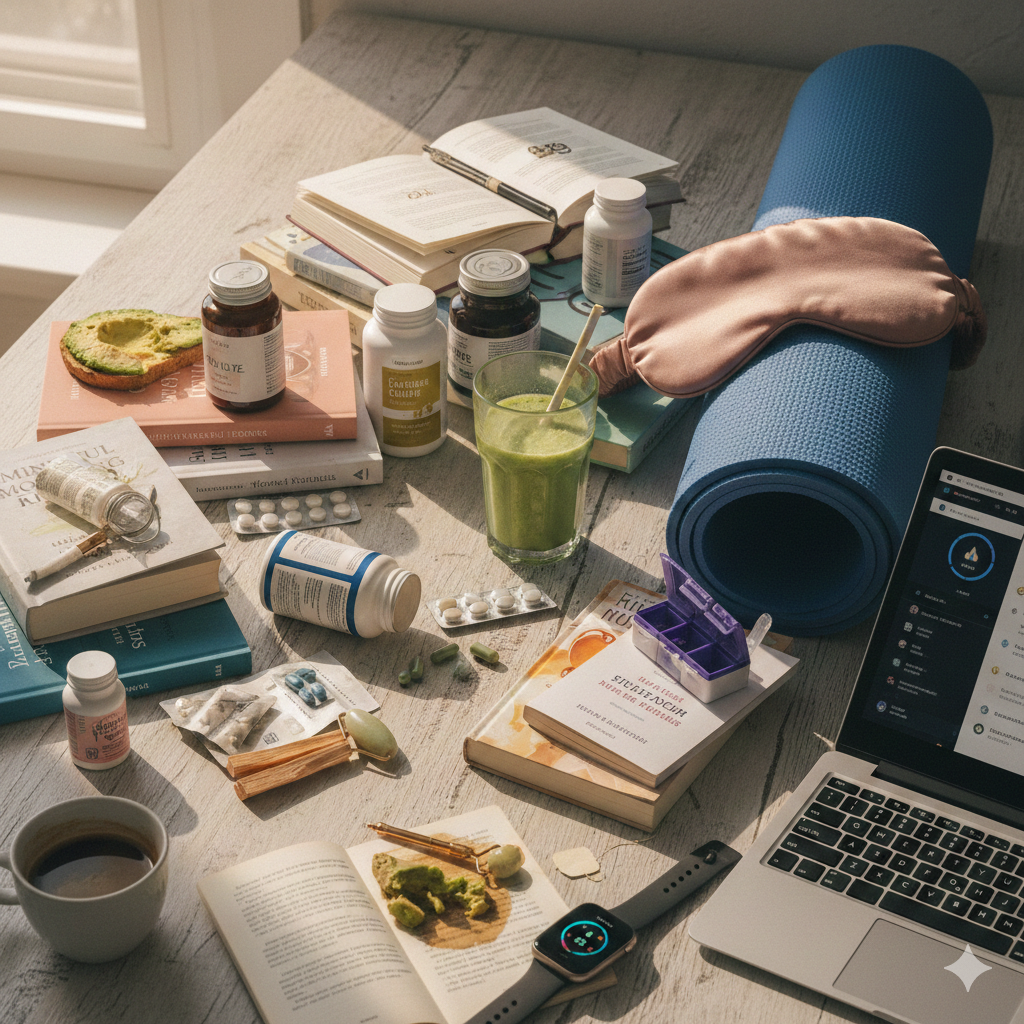
Here’s the nuance that gets lost:
None of that advice is necessarily wrong. Hydration matters. Quality sleep matters. Movement matters. I talk about all of these things in my own work because they genuinely do make a difference.
But here's what's missing from the conversation: those individual pieces rarely fix the whole problem on their own. Tiredness isn't usually caused by one thing. It's caused by a combination of factors and that combination is different for every person. So when you follow a generic tip and it doesn't transform your energy, it's not because the advice was bad. It's because it was incomplete.
The energy drains hiding in plain sight
And some of the biggest drains aren't the ones you'd expect. It might be the hour of scrolling before bed that feels like "rest" but is actually keeping your nervous system on high alert. It might be the constant low-level people-pleasing that leaves you with nothing for yourself. I wrote about this in 5 not so obvious things that could be draining your energy— the energy drains hiding in plain sight are often the ones no generic list will ever mention, because they're deeply personal.
The Quiet Shame Nobody Talks About
And that's where the self-blame creeps in. You tried the "right" things and still feel exhausted, so you start to wonder if the problem is you. Maybe you're not disciplined enough. Not committed enough. Not trying hard enough.
This is the quiet shame that nobody talks about. The tiredness is hard enough. But the self-blame that comes from doing all the "right" things and still feeling exhausted? That's what really keeps you stuck. It chips away at your confidence and makes you less likely to try again. The opposite of what you need.
When you've done everything 'right' and you're still exhausted, you don't just feel tired, you feel lazy. Flaky. Like you're lacking the willpower everyone else seems to have. So you stop trying. You settle. And that quiet settling, accepting this is just how life feels now, is heavier than any fatigue.
What If It' Not You. What If It's The Approach?
Generic wellness advice was never designed for you specifically. It was designed for everyone, which means it was designed for no one. I've written before about why it's so important to ditch the one-size-fits-all advice and tune into your intuition — and this is exactly why.
Why that listicle will never have the answer
That listicle promising "10 ways to boost your energy" has absolutely no idea what's actually draining yours. It doesn't know that your exhaustion might have less to do with hydration and more to do with the fact that you haven't had a single uninterrupted hour to yourself in three weeks. It doesn't know that your afternoon crash isn't about blood sugar, it's about the emotional weight of a role that stopped lighting you up two years ago. Or that your morning fatigue has less to do with sleep quality and more to do with the low-level dread of a day that's entirely built around other people's demands.
Your combination is unique

The reasons for fatigue in females are as varied as the women experiencing them. Hormonal shifts. Gut health. Emotional load. Seasonal changes. Relationship dynamics. Work patterns. Unprocessed grief. Nutritional gaps that are unique to your body's chemistry. The list is genuinely endless and the combination is different for every single person.
That's precisely why generic advice alone keeps you spinning in the same exhausting cycle: try, fail, blame yourself, try something new, repeat. Not because the advice is wrong, but because individual tips that don't account for YOUR unique combination can never be the full answer.
The Missing First Step To Getting More Energy
So what does work?
What if the answer isn't another hack or layering one more thing onto your already-overflowing routine? What if the real starting point is something much simpler? Actually understanding what's draining YOU.
Not what's draining women in general. Not what some expert says is probably the issue. What's specifically depleting your energy, in your body, in your life, right now.
Curiosity before discipline
This is the difference between following someone else's protocol and building your own understanding. Discipline and consistency matter. But they're only powerful when they're pointed in the right direction. And you can't know the right direction until you understand what's actually draining you. That's where curiosity comes in. Not as a replacement for discipline, but as the essential first step that makes discipline worthwhile.
When you start paying attention to your own patterns. When you notice which days you feel more alive and which days you crash, what you ate, how you slept, what emotions were swirling, who you spent time with, what time of the month it is, something shifts. You stop looking outside yourself for answers and start recognising that the data has been there all along. You just hadn't been tracking it.

This is awareness-first living. Not another diet to follow. Not another routine to master. Not another guru telling you what to do. Just honest, curious observation of what your body is already trying to tell you. And once you start listening? The picture gets remarkably clear, remarkably quickly.
Why awareness comes before action
Most approaches to how to get more energy start with action. Do this. Take that. Change this habit. But action without understanding is just throwing darts in the dark. Awareness comes first. Action follows naturally and when it does, it's personalised to you. Which is why it actually sticks.
I've Been Exactly Where You Are
I spent years caught in this cycle. Reading books on wellness. Listening to podcasts. Trying every approach that promised results. The supplements, smoothies, veggie diets, meditation, fitness protocols. Feeling like I was constantly on the edge of cracking the code, only to find myself feeling like I was back at square one: tired, frustrated, and quietly doubting myself.
The approach that changed everything
The truth is, I was never really back at square one. Everything helped a little. The shift doesn't happen in one big bang, it's always gradual. But the frustration came from being promised the next protocol would be the solution.

Over time, I started tracking my own patterns, really tracking them, with honesty and curiosity rather than judgement. And it was only through doing that, through actually paying attention, that I realised there wasn't one right answer. There was my answer. I just hadn't been looking in the right place.
And what I discovered genuinely surprised me. Things I'd assumed were helping were actually part of the problem. Things I'd dismissed as unimportant turned out to matter enormously. The patterns were hiding in plain sight. I'd just never stopped long enough to look. I realised each new habit, each choice I made to do less of something or more of something, moved me closer to learning my own recipe. And in some cases, it meant noticing the times my energy was actually good — and understanding why.
That experience is what led me to create The Energy Tracker Method (at the heart of my upcoming book series) because I realised that no one else could tell me why I was tired. The reasons are too personal, too layered, too individual. Combining tracking with journalling eliminated the guesswork and replaced it with personal insight. Not someone else's prescription. Not a generic protocol. My own understanding, built from my own data.
And that changed everything.
Want to Try Something This Week?
For the next three days, simply notice your energy. Not with an app. Not with a complicated system. Just with curiosity.
When you feel more awake or alive, jot down what you were doing, eating, feeling, and what time it was. When you crash or feel that familiar heaviness, do the same. No judgement. No attempting to fix anything. Just gentle, honest observation.
Your 3-day Energy Experiment
Simply notice and note. When do you feel most alive? When do you crash? What were you doing, eating, feeling? No fixing, just curious observation. The patterns are already there. You simply need to start paying attention to them.
You might be surprised by what emerges. And that first moment of "oh, that's what's going on" is genuinely powerful. It's the beginning of understanding your own energy on your own terms.

Ready to Take It Further?
The first step is understanding what types of tired you're experiencing, because not all tiredness is the same.
I've created a free guide to help you start: Shake Off The Tired Vibes: 5 Simple Ways to Revitalise Your Energy. Inside, you'll discover the 5 different types of tired (and which ones you might be experiencing) along with 5 simple remedies you can try right now — breathwork, hydration, movement, grounding, and inspiration.
No gurus telling you what to do. No one-size-fits-all rules to follow. Just an invitation to get curious about your own vitality.
Frequently Asked Questions
-
Tiredness is rarely caused by one single factor. You might be sleeping well and staying hydrated but still experiencing fatigue because of emotional load, hormonal shifts, seasonal changes, or a dozen other factors unique to your life. Generic advice addresses individual pieces, but until you understand your specific combination of energy drains, the full picture stays hidden.
-
Not necessarily. Things like drinking enough water, getting quality sleep, and regular movement genuinely matter for energy. The issue is that these individual tips are incomplete on their own. They address one piece of a much larger puzzle. When they don't work in isolation, it's not because the advice is bad, it's because your tiredness is more complex than any single tip can solve.
-
Generic advice gives everyone the same starting point regardless of their individual circumstances. A personalised approach starts with awareness, tracking your own energy patterns, noticing what drains and restores you, and using that data to build an understanding of what YOUR body actually needs. It's the difference between following someone else's blueprint and creating your own.
-
Photo by Vitaly Gariev on Unsplash
Photo by Kelly Sikkema on Unsplash
Photo by Sweet Life on Unsplash